

Welcome to The Cybersecurity Pulse (TCP)! I’m Darwin Salazar, Head of Growth at Monad and former detection engineer at Datadog. Each week, I bring you the latest security innovation and industry news. Subscribe to receive weekly updates! 📧
Hi 👋 - Hope you’re having a great week wherever you’re reading from!
On the personal front, I was able to take some time off to enjoy America’s 250th birthday. Threw a spa day in there and experienced this alien piece of work that I can’t recommend enough. Aside from that, some World Cup shenanigans. It’s been a great one although my dark horse, Cabo Verde, has been eliminated.
Before we jump into the news, in a few weeks I’ll be partnering with my dear friend Mitchem to share our thoughts on AI SOC, detection engineering, and why the data layer is becoming the whole game. You can register for the webinar here 👾
Lastly, Hacker Summer Camp is coming up. Here’s where I’ll be at all week. DM me if you wanna grab a coffee or lift weights!
Now, onto the news!
Introducing Gist Security - Fear No Change
Engineering and IT now build faster than security can review, and AI only widens the gap. Gist embeds governance into the change lifecycle itself, to produce consistent, auditable risk assessments, threat models, and evidence records.
TL;DR ✏️
⚖️ Anthropic sues Abnormal: Abnormal says it used abnormal.ai and the slash wordmark before Anthropic existed.
🧪 Ransomware gets an AI intern: Vendor says they discovered first fully autonomous ransomware, but it required a human
🪪 Robinhood fixes approvals: SERA speeds up passkey-based approvals for incident response and sensitive access.
🧠 Stop bolting AI onto 2003: Anton Chuvakin says AI SOCs need process redesign before agents enter the queue.
🇲🇽 World Cup pressure test: Mexico’s cyber plan puts critical infrastructure investment on a five-year clock.
🤖 Straiker raises $64M: Straiker raised a Series A for AI agent discovery, testing, and runtime protection.
Plus: Runlayer raises $30M, Aikido acquires Root, Nebulock raises $25M, MSP identity consolidates, poisoned MCP tools keep being annoying, and Intruder adds a free exposure-management onramp.
⚒️ Picks of the Week ⚒️
Anthropic sues Abnormal over AI branding
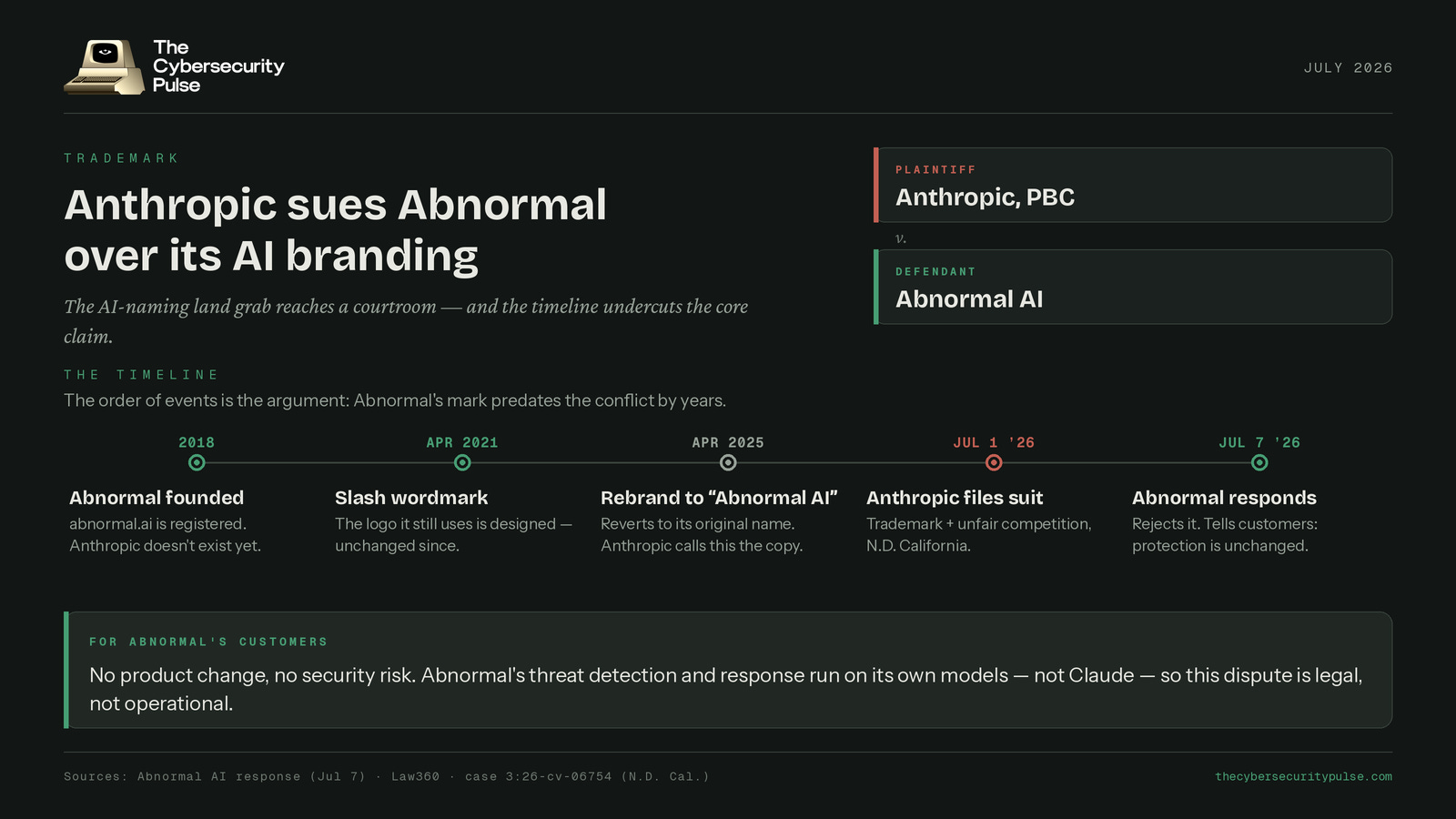
Anthropic filed a public lawsuit against Abnormal AI on July 1, claiming unfair competition and trademark infringement over Abnormal’s slash-based AI branding. Abnormal’s CEO wrote a blog post here detailing their side of the matter.
Abnormal was founded in 2018, registered abnormal.ai before Anthropic existed, and has used the same slash-based wordmark since April 2021. The CEO also says it is a large Anthropic customer, learned about the lawsuit from a reporter, not directly from Anthropic.
I’m not sure what wires got crossed here but this seems super out of left field from Anthropic. Is there something more to it?
Will be following this one closely
Enterprise Incident Response for the AI Era
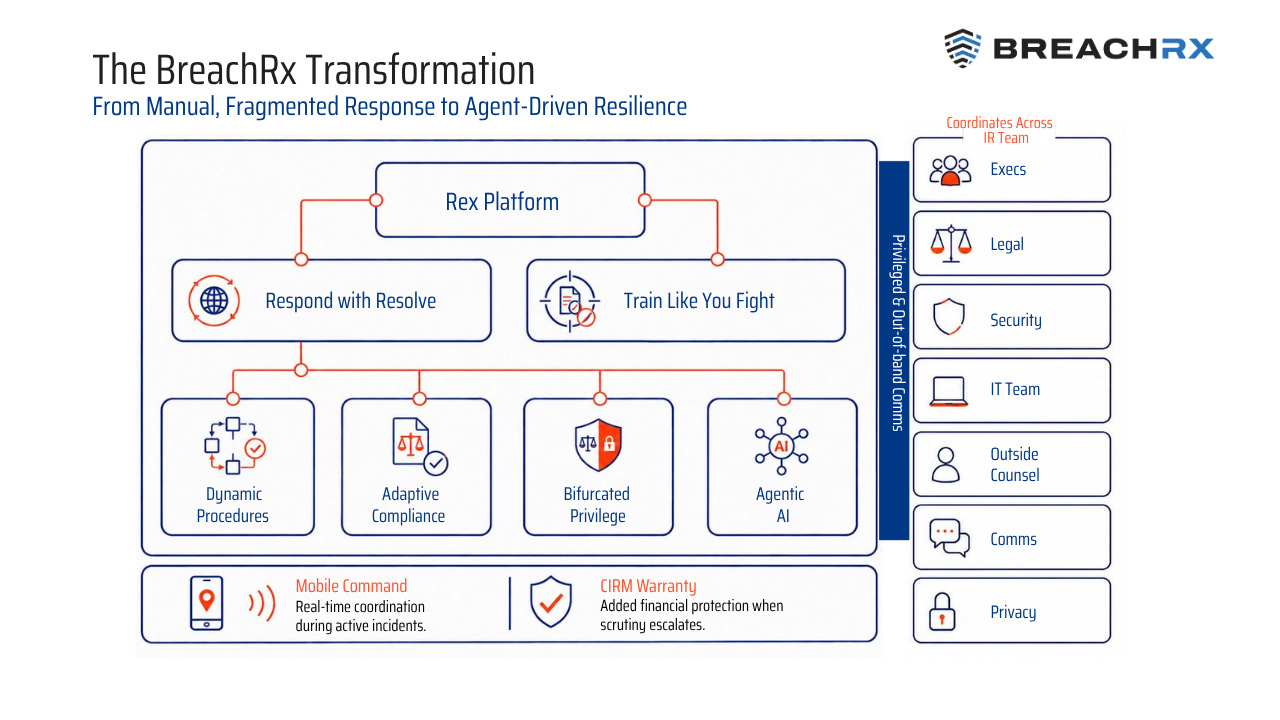
Offensive AI is making attacks faster, easier to launch, and harder to manage at enterprise scale. BreachRx helps organizations move from breach chaos to coordinated Enterprise Incident Response, using agentic AI to guide workflows, surface obligations, coordinate stakeholders, and preserve evidence in one platform.
Teams train like they fight, leaders stay aligned, regulators get consistent facts, and every stakeholder can respond with resolve when it matters most.
Ransomware Gets an AI Intern
This weekend I came across some headlines about the “first fully autonomous ransomware attack”. But after some digging, I discovered there were humans involved!!! Gotta love bait headlines. TechCrunch reported that a human still chose the victim, provisioned infrastructure, and supplied database credentials. The AI agents did the rest.
Sysdig says JADEPUFFER hit an exposed Langflow instance through CVE-2025-3248, then pivoted into a production MySQL and Nacos server. The agent encrypted 1,342 Nacos configuration items, dropped original config and history tables, created a ransom note, and generated an encryption key that was printed once, never stored, and never sent anywhere. “an adaptive and fully automated campaign,” is what they are calling it but it did still need a human.
In any case, this is another reminder that attackers use AI to compress the tedious bits. Not a nothing burger but also not something to rewrite your security program around.
Robinhood rebuilds access approvals for speed
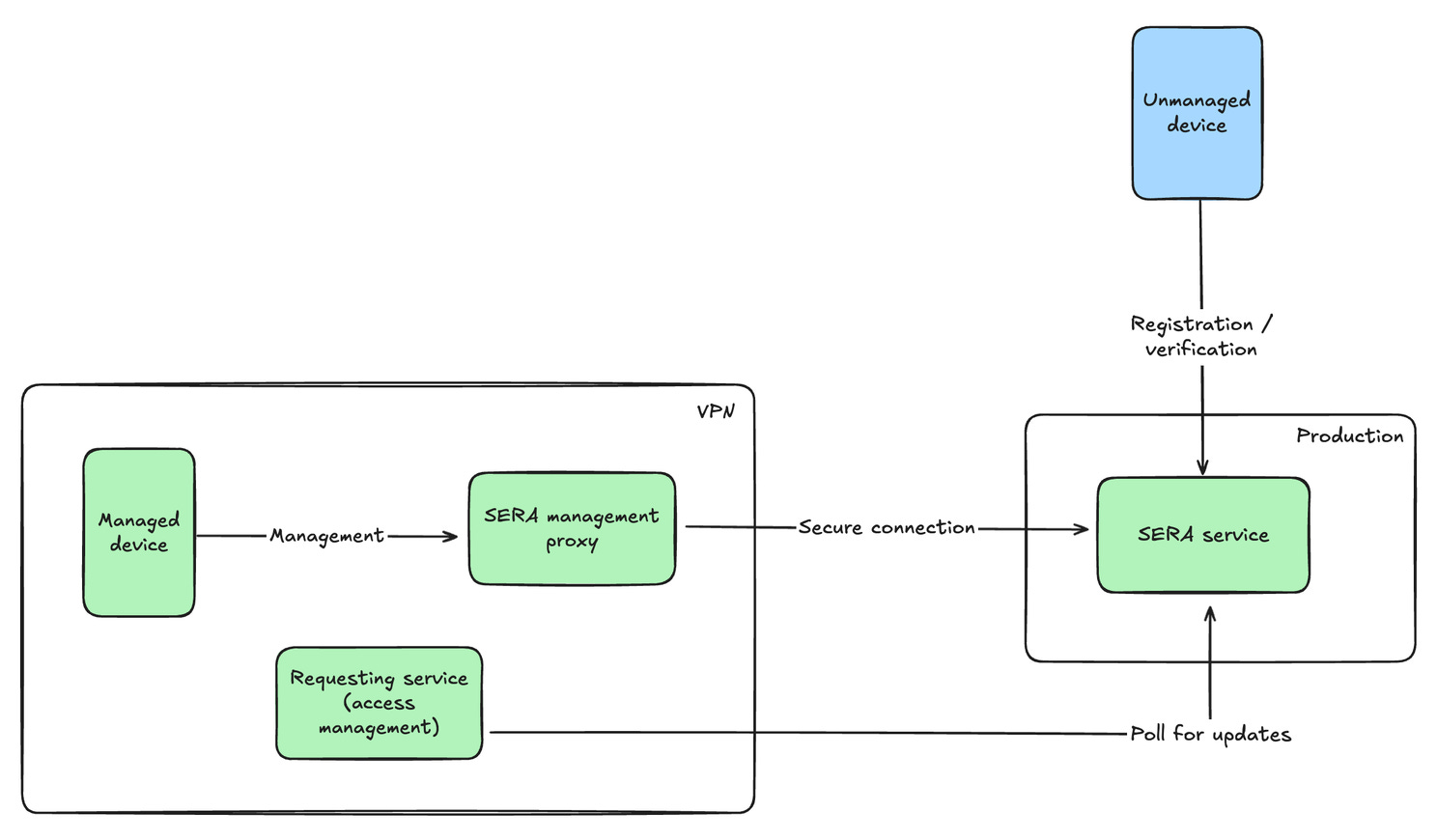
Access approvals get painful fast when the approver has to be on a managed laptop, on VPN, and available during an incident. Robinhood built Secure Enhanced Remote Approval, or SERA, so devs can approve access from any device using passkeys, without VPNs or managed laptops. The company says SERA cut approval time by 20% and shipped in four months after incident response and engineering teams kept running into approval friction.
This is a useful playbook for teams with global engineering, 24/7 systems, sensitive data, cloud sprawl, or break-glass workflows. Approval shows up during production debugging, incident response, privileged admin actions, temporary elevation, and access to sensitive environments.
Side note - The OP was written in Nov’ of ‘25 but DarkReading recently picked it up which piqued my curiosity.
Anton Chuvakin wants SOC teams to stop bolting AI onto 2003
Anton Chuvakin argues the AI SOC conversation is too tool-heavy and too light on people and process. His warning is simple: agents added to a legacy SOC can preserve the same broken workflows with better autocomplete.
He’s right. Validation, handoffs, metrics, detection quality, feedback loops, and analyst development all need serious thought and maybe redesign before agents get bolted on, otherwise you’re just automating what was already broken. Worth following his Medium and reading in full.
I’m touch and see the problems he highlights first-hand at Monad and I couldn’t agree more. Fundamentals still matter. AI is not coming to save your SOC.
World Cup Pressure Tests Mexico’s Cyber Plan
Recorded Future says Mexico’s 2025–2030 National Cybersecurity Plan is trying to formalize national cyber coordination after years of ransomware, fraud, hacktivism, data theft, and state-linked activity. The past 5 years have been rough for Mexico on the cyber front and with co-hosting the World Cup, I’d imagine security was front and center.
The 2026 phase calls for a national cyber strategy, a General Cybersecurity Law, a National Center for Cybersecurity Operations, CSIRT coordination, critical infrastructure identification, and federal vulnerability assessment.
TLDR: Lots of investment pouring into securing Mexican critical infrastructure over the next 5 years. All countries should be doing the same.
Straiker raises $64M for agent security
Straiker raised a $64M Series A to expand its AI agent security platform. The round was led by Marathon Management Partners, Citi Ventures, Illuminate Financial, and Workday Ventures, with continued backing from Bain Capital Ventures and Lightspeed.
Straiker helps teams find agents already running, monitor live prompts/tool calls, and test new agent workflows before they get real permissions. The company was founded by Ankur Shah, former SVP and GM of Prisma Cloud at Palo Alto Networks, and Sreenath Kurupati, former Akamai AI and security research lead.
They’re one of my favorite AI security startups right now: serious team w/ big scale vendor track record, serious problem, and early enough to give the bigger platforms a real headache.
🔮 The Future of Security 🔮
AI Security
Runlayer raises $30M for agent governance
Runlayer raised a $30M Series A from Felicis and Khosla Ventures, bringing total funding to $42M. The company gives enterprises one control layer for AI agents, MCP servers, and AI clients, with identity, permissions, policy enforcement, audit logs, and real-time visibility tied to agent actions.
I remember doing a demo with their CEO, Andy, earlier this year and was blown away around how intuitive and ahead the product was in securing MCP for enterprise tooling at a time where teams were still understanding how to secure it. Also, strong signal that Vinod Khosla wanted “every available dollar” of their Series A. Good stuffs.
More AI Security News
Identity and Access Management
Barracuda buys Evo Security for MSP identity
Barracuda acquired Evo Security, an IAM and PAM provider built for MSPs. Barracuda says Evo will expand BarracudaONE with privileged access management, access control, identity protection, and identity threat detection and response. Terms were not disclosed.
Software Supply Chain Security
Aikido acquires Root for open-source patching
Aikido Security acquired Root add software supply chain patching into its platform. Root generates CVE patches for package versions teams already run, while Aikido is launching patched drop-in libraries and container images. Deal rumored to be around $80-100M.
“Acquiring Root” in a company transaction is probably a once-in-a-lifetime opportunity and I’m glad it was Aikido. The puns write themselves. In all seriousness, Aikido is a rocketship and has one of the best GTM + eng teams in the game.
Side note: Both Aikido + Root are past sponsors of TCP so I’m super happy to see them winning!
Security Operations
Nebulock raises $25M for hunt-first security ops
Nebulock raised a $25M Series A led by FirstMark, with Bain Capital Ventures, Decibel, Zetta Venture Partners, and Step Function participating. The company is building hunt-first security ops.
The idea is simple: the bad stuff increasingly looks normal until you connect the sequence. Nebulock is focused on that middle layer, where valid creds, weird agent behavior, and quiet pivots start to look less innocent.
I’m bullish on the team + problem space. A lot of finding “the needle in the haystack” depends on correlation and piecing things together over long windows of time. That’s where Nebulock really helps.
More Security Operations News
Vulnerability Management
Intruder launches a free exposure management plan
Intruder launched a permanent free plan for lean security teams, with weekly scans for up to 5 external targets, one cloud environment, 2 container images, port change monitoring on 80 and 443, unlimited remediation scans, one AI pentesting credit per month, and up to 3 users.
This is a great way to help SMBs and a neat onramp into Intruder’s pipeline.
Interested in sponsoring TCP?
Sponsoring TCP not only helps me continue to bring you the latest in security innovation, but it also connects you to a dedicated audience of 20,000+ CISOs, practitioners, founders, and investors across 135+ countries 🌎
Bye for now 👋🏽
That’s all for this week… ¡Nos vemos la próxima semana!
Disclaimer
The insights, opinions, and analyses shared in The Cybersecurity Pulse are my own and do not represent the views or positions of my employer or any affiliated organizations. This newsletter is for informational purposes only and should not be construed as financial, legal, security, or investment advice.
Thank you for cutting through the "fully autonomous" ransomware headline. This is the same vendor-marketing pattern I see in security questionnaires: threat actors get a sensational label while the actual finding, a human still chose the target and supplied credentials, gets buried in paragraph three. Defender questionnaires are still written for a slower era than the automation attackers already have in production.