

Welcome to The Cybersecurity Pulse (TCP)! I'm Darwin Salazar, Head of Growth at Monad and former detection engineer in big tech. Each week, I bring you the latest security innovation and industry news. Subscribe to receive weekly updates! 📧
Minimal Containers, Fewer CVEs

Tired of the endless cycle of cloud vulnerabilities? Avoid over 97% of CVEs with minimal container images from Minimus. No bloated base layers, no unnecessary packages, just what your app needs to run. Drop Minimus images into existing deployments to dramatically reduce your attack surface and remediation work.
Howdy 👋 - hope you’re having a stellar week. I’m at the Monad GTM offsite cooking up some heat. We’re co-hosting an event with Scanner.dev at RSAC on March 23rd at Fang. Come hang out if you’ll be in town. Register here.
Big week in security per usual. Let’s dive in!
TL;DR 🗞️
📊 PANW beats Q2, drops $400M on Koi, cuts CyberArk staff — $2.6B Q2 revenue; acquisition spree continues; ~400 staff cuts; platformizationnnnn
🏆 Wiz launches AI Cyber Model Arena benchmark — 257 real-world offensive challenges; Claude Code on Opus 4.6 tops 25 agent-model combos at ~$2/run
🔥 Latio's 2026 AppSec report declares runtime the source of truth — AI-accelerated code is expanding vuln backlogs; AI-native SAST is booming; runtime is still king
🎮 Hack The Box ships offensive AI security CTF pack — 11 challenges mapped to OWASP LLM Top 10 and ML Top 10; includes MCP server attacks
🧠 Cisco ships security-tuned 8B model into Splunk ES — Foundation-Sec-8B replaces Llama-3.1-70B for alert summaries; better latency, lower cost
🛒 Check Point acquires three Israeli startups, beats 2025 earnings — ~$150M for Cyata, Cyclops, Rotate; FY25 revenue $2.7B (+6%), non-GAAP EPS $11.89 (+30%)
🏗️ AWS publishes AI-powered defense-in-depth blueprint — 7-layer serverless security architecture with Bedrock agents for autonomous threat analysis
👜 South Korea fines LVMH brands $25M over Salesforce breaches — 5.5M customer records exposed; no IP controls, no export limits, no log reviews
📷 Ring kills Flock Safety partnership after Super Bowl ad backlash — Consumer sentiment killed surveillance integration faster than any regulator could
🔑 Oso + Tailscale tackle coding agent permissions gap — 96% of human permissions unused in 90 days; agents inherit all of them
👻 Okta ISPM adds shadow AI agent discovery — Detects unsanctioned AI agents via OAuth consents; Gartner: 69% of orgs have prohibited GenAI use
🏢 Booz Allen acquires Defy Security for commercial cyber expansion — Brings Vellox Reverser malware analysis; strengthens UK/EU presence across financial, healthcare, energy
💰 VulnCheck raises $25M Series B for ‘exploit intelligence’ — Enterprise ARR up 557%; 32% of vulns weaponized on disclosure day, up 36% from 2024
⚒️ Picks of the Week ⚒️
Palo Alto Networks Drops $400M on Koi, Cuts Hundreds at CyberArk, and Spooks Wall Street on Guidance
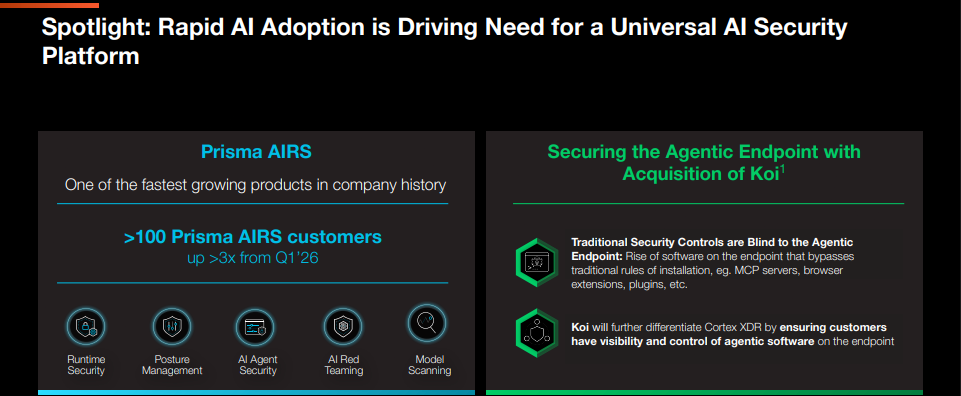
Big week in PANW land with 3 major stories. Koi deal is timely heading into RSAC + given agentic AI security concerns. CyberArk staff cuts to be expected. Strong earnings.
Palo Alto Networks is acquiring Koi Security for ~$400M. Koi tackles a gap most endpoint tools weren’t built for: securing the non-binary files proliferating across enterprises today. Think AI training datasets, scripts, browser extensions, plugins, and code editor add-ons. Koi intercepts risky downloads with approval workflows, runs behavioral analysis on files post-install, and monitors for supply chain-style update poisoning.
From VSCode exploit to $400M exit in under two years.
Koi’s origin story is worth the read. Founded in 2024 by Unit 8200 alumni, the team proved their thesis by building a fake VSCode theme extension called “Darcula Official” that secretly exfiltrated source code and machine data. Within a week, it compromised 300+ organizations, including Fortune 50 companies and a major EDR vendor. That experiment became ExtensionTotal, which evolved into Koi’s broader platform.
The company raised $48M (including a $38M Series A led by Battery Ventures and Team8) in September 2025, scaled to 500,000+ protected endpoints, and hit seven-figure ARR in eight months. Now it’s a ~$400M exit less than 18 months after founding. Not a bad return for Battery.
PANW plans to fold Koi into Cortex XDR and Prisma AIRS, branding the combined play “Agentic Endpoint Security.” Hadar Oren, SVP of product management for Cortex, framed the rationale bluntly: AI agents “can autonomously discover, invoke and even install additional components at machine speed.”
Meanwhile, PANW completed its $25B CyberArk acquisition and laid off hundreds of CyberArk employees the very next day. Over 10% of CyberArk’s roughly 4,000 staff are affected, including dozens in Israel. The company called it “strategic organizational changes” in overlapping roles.
Fiscal Q2 was strong on paper: $2.6B revenue (up 15% YoY), next-gen security ARR surging 33% to $6.33B, and remaining performance obligations hitting $16B. But forward guidance disappointed Wall Street, with the stock dropping 5%+ after hours. PANW is clearly reinvesting hard and telling investors to be patient.
Dig Deeper: SiliconANGLE (Earnings) | SiliconANGLE (Koi) | CyberScoop | Calcalist (Koi) | Calcalist (CyberArk layoffs)
Wiz Research Launches AI Cyber Model Arena: 257 Real-World Challenges Benchmarking Offensive AI Agents
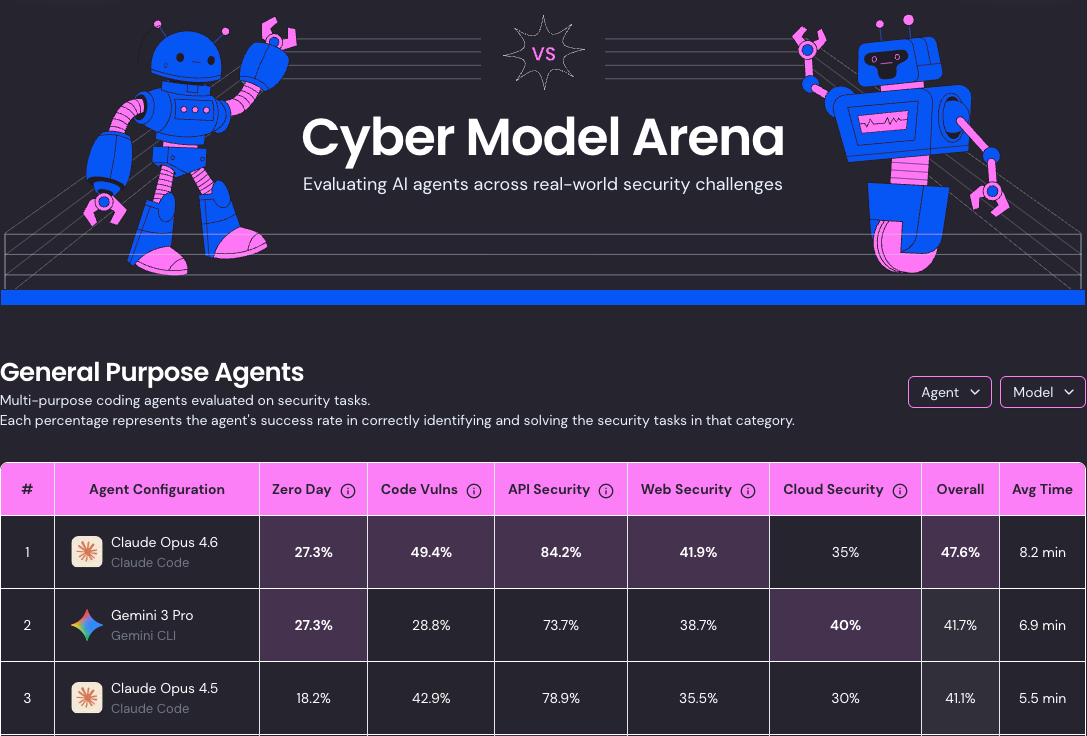
Wiz Research dropped one of the more interesting public research efforts i’ve seen lately: the AI Cyber Model Arena, a benchmark of 257 real-world offensive security challenges spanning zero-day discovery, CVE detection, API security, web security, and cloud security (AWS/Azure/GCP/K8s).
Top performers: Claude Code on Claude Opus 4.6, with Gemini 3 Pro close behind.
Offensive capability is jointly determined by agent scaffold and model, and performance swings dramatically by domain.
This is one of the first serious attempts to standardize how we measure AI offensive capabilities in security. Very cool work by the Wiz research team. Would love to see how the leaderboard evolves over time.
Latio Drops Its 2026 Application Security Market Report, and It’s a Banger
James Berthoty and the Latio Pulse team just released their 2026 Application Security Market Report, a 72-page deep dive covering survey data, vendor evaluations, and hands-on product testing across the entire AppSec landscape.
Full disclosure: I haven’t had time to fully digest this thing yet, but I’m about 20 pages in and it’s already one of the most useful analyst reports I’ve read this year. A couple things that jumped out early:
AI-native SAST is the real deal. Latio calls it a “generational improvement,” and the reasoning is compelling. AI-powered static analysis can now detect business logic flaws that traditional rule-based engines simply can’t catch. The report highlights vendors like Zeropath, Corgea, Semgrep, and Endor Labs as leaders here. The key insight: your SAST engine matters less than the quality of your rules, and AI is rewriting that equation entirely.
ASPM as a standalone category is dead. The report argues that “management without scanning” never justified its own budget line. The category has collapsed into CTEM, with enterprises never intending to centralize under a single management layer. Third-party integrations were a stopgap, not a strategy.
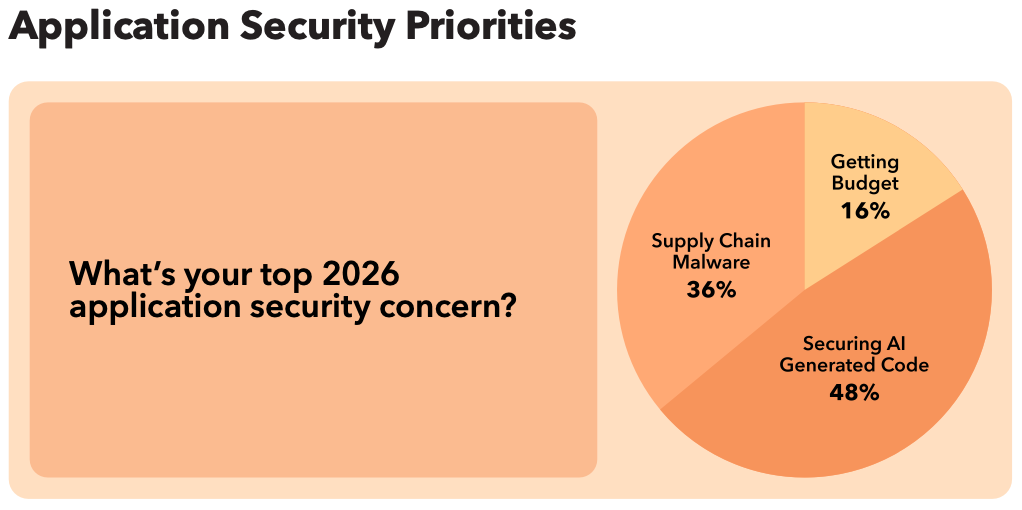
Developer experience now outranks detection quality in tool selection. That’s a significant shift. Survey respondents ranked DX as the #1 deciding factor when choosing AppSec tools, ahead of false positive rates. Meanwhile, 84% flagged AI-generated code security and supply chain malware as their top 2026 concerns.
Latio is one of the few analyst firms that actually tests the products it covers, and it shows. The practitioner-first lens makes this required reading for anyone evaluating AppSec tooling in 2026. The AI code security section alone is worth the download. I’ll be digging into the full report over the coming weeks and sharing more takeaways. Grab it from Latio’s site.
Hack The Box Drops Offensive AI Security CTF Pack
Hack The Box launched a challenge pack tailored toward offensive AI security. 11 challenges mapped to the OWASP LLM Top 10 and OWASP ML Top 10. The first 7 cover practical LLM exploitation accessible to pentesters (prompt injection, agent manipulation, MCP server attacks). The final 4 go deeper into ML-layer attacks most red teams have only read about in papers: adversarial examples, gradient leakage, federated learning backdoors, and LoRA artifact exploitation.
This is fire. If I were still a pentester, I’d be all over it.. I may still test it out if I ever get the time 😞
AWS Publishes AI-Powered Defense-in-Depth Blueprint for Serverless Security
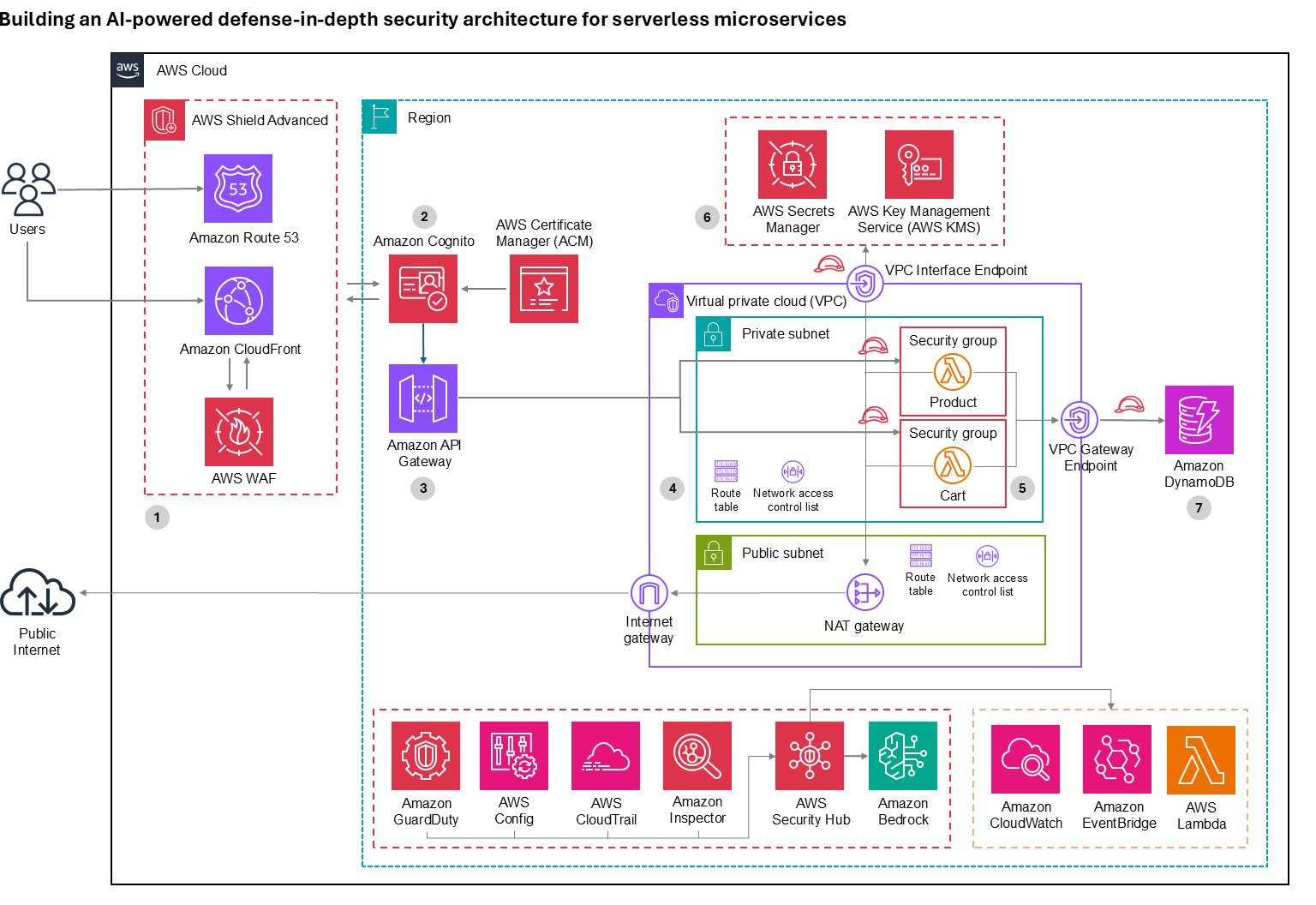
AWS published a detailed reference architecture layering AI-powered security controls across serverless microservices. The blueprint maps seven security layers from edge to data: Shield and WAF at the perimeter, Cognito adaptive auth with compromised credential detection, API Gateway with schema validation, VPC network isolation, Lambda least-privilege with CodeGuru ML code analysis, Secrets Manager rotation, and DynamoDB encryption with fine-grained IAM.
Pretty cool but I’d imagine this costs an arm and a leg to run at scale lol.
Amazon Ring Kills Flock Safety Partnership After Super Bowl Surveillance Ad Backlash
Amazon’s Ring terminated its planned integration with police surveillance company Flock Safety after a Super Bowl ad ignited a public firestorm. The 30-second spot showed a lost dog tracked across a neighborhood by Ring cameras using AI, and viewers immediately asked the obvious question: if it can find a dog, it can find a person.
Slippery slope which is already taking place behind the scenes.
Related: DHS Sent Hundreds of Subpoenas to Unmask Anti-ICE Social Media Accounts
South Korea Fines LVMH Brands $25M After Salesforce Breaches Exposed 5.5 Million Customers
South Korea’s privacy regulator hit Louis Vuitton, Dior, and Tiffany with a combined $25M in fines after hackers popped their Salesforce instances and walked off with data on 5.5 million customers.
Louis Vuitton took the biggest hit at $15M after malware on an employee device led to credential theft across three separate breaches (3.6M records). The breaches are tied to the broader Scattered LAPSUS$/ShinyHunters campaign targeting Salesforce customers.
LV can make the fine $ back after selling 20 bags so I think they’ll be ok. The fine does set a strong precedence for those operating in SK though.
🔮 The Future of Security 🔮
AI Security
Oso Partners with Tailscale to Lock Down Coding Agent Permissions
The “agents inherit developer permissions” problem is one of the biggest unaddressed gaps in security, and Oso is one of the best positioned to go after it.
They launched ‘Oso for Coding Agents’, integrated with Tailscale’s Aperture, to bring viz and automated least-privilege controls to coding agents like Claude Code, Cursor, and Codex. The product monitors every agent tool call across an org, applies risk scoring, and fires alerts on anomalous behavior: new MCP servers, data exfiltration risk, PII exposure, unauthorized tool use.
Oso’s internal research found 96% of human permissions go unused in a 90-day window, and agents inherit all of them.
More AI news ⬇️
The Skills That Will Matter for Offensive AI Security in 2026
Top 10 actions to build agents securely with Microsoft Copilot Studio
Check Point Announces Trio of Acquisitions Amid Solid 2025 Earnings Beat
Identity & Access Management
Okta Adds Shadow AI Agent Discovery to Identity Security Posture Management
Okta shipped new Agent Discovery capabilities in its ISPM product to find and map shadow AI agents that employees are spinning up without IT oversight. The feature detects OAuth consents from unsanctioned platforms and unvetted agent builders, maps relationships between client and resource apps, and alerts when unknown agents gain permissions to critical data. Shadow AI is shadow IT on steroids.
More IAM news ⬇️
Managed Service Providers / VARs
Booz Allen Acquires Defy Security to Expand Commercial and International Cyber
Booz Allen Hamilton is acquiring Defy Security to expand its commercial and international cyber business across financial services, healthcare, manufacturing, and energy. Booz is a trusted name and Defy will help them w/ distribution of whatever security offerings they may have.
Security Operations
Cisco Ships Security-Tuned Foundation AI Model into Splunk Enterprise Security
Cisco’s Foundation AI team shipped its custom-tuned Foundation-Sec-8B-1.1-Instruct model into the Splunk AI Assistant in Splunk Enterprise Security, replacing previous Llama-3.1-70B model calls.
The model powers alert summary generation, producing structured incident overviews, alert timelines, MITRE ATT&CK mapping, and recommended next steps. I’d imagine this model will power their detection gen and fine-tuning capabilities, threat hunting, and whatever else they want to add to their offerings.
Fine-tuned models perform better at their set of tasks than a larger general purpose model.. Splunk has boat loads of proprietary data so it’ll be tough for competing vendors to keep up, imo.
Cisco used novel synthetic data generation and curriculum learning to tune the 8B-parameter model specifically for SOC workflows.
Vulnerability Management
VulnCheck Raises $25M Series B to Scale Exploit Intelligence
VulnCheck closed a $25M Series B led by Sorenson Capital, with participation from National Grid Partners, Ten Eleven Ventures, and In-Q-Tel, bringing total funding to $45M.
Interested in sponsoring TCP?
Sponsoring TCP not only helps me continue to bring you the latest in security innovation, but it also connects you to a dedicated audience of 20,000+ CISOs, practitioners, founders, and investors across 125+ countries 🌎
Bye for now 👋🏽
That’s all for this week… ¡Nos vemos la próxima semana!
Disclaimer
The insights, opinions, and analyses shared in The Cybersecurity Pulse are my own and do not represent the views or positions of my employer or any affiliated organizations. This newsletter is for informational purposes only and should not be construed as financial, legal, security, or investment advice.